

Product Description
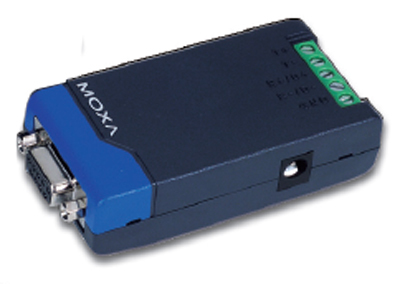
- Port-powered RS-232 to RS-422/485The TCC-80/80I provides complete signal conversion between RS-232 and RS-422/485. without requiring an external power source.
- It supports both half duplex 2-wire RS-485 and full duplex 4-wire RS-422/485. either of which can be converted between RS-232's TxD and RxD lines.
- In addition.the TCC-80/80I's 15 KV ESD protection guards against damage from electrostatic discharge.
- The TCC-80I is the world's first high-speed. port-powered converter with 2.5 KV isolation.
- Automatic data direction control is also provided for RS-485. in which the RS-485 driver is enabled automatically when the circuitry senses the TxD output from the RS-232 signal.
- This means that no programming effort is required to control the transmission direction of the RS-485 signal.
- Moreover. the TCC-80I patented LED port power indicator can let you check if TCC-80I is receiving enough power or not.
- Port Power over RS-232The RS-232 port of the TCC-80 is a DB9 female socket that can connect directly to the host PC. with power drawn from the TxD.
- RTS. or DTR line.
- Regardless of whether the signal is high or low. the TCC-80 can obtain enough power from the data/handshake line.
- However. external power can be used if the handshake line is not available. if the serial cable is too long. or if the RS-232 device is a low power device.
- For external power. a 5 to 12 VDC power supply can be connected using an adaptor or a USB power cord.
- Port Power DissipationWhen installing a TCC-80 converter. it is important to pay attention to power consumption.
- RS-232 cable length. and RS-422/485 transmission distance.
- In general. the TCC-80 obtains 50 mW from the power source.
- Standard PC COM ports can provide 70 to 90 mW of power if the TxD.
- RTS. and DTR lines are connected.
- Moreover. the RS-232 cable should be shorter than 15 m (@ 9600 bps) to ensure that less power is lost from the host/device to the TCC-80.
- The remainder of the supplied power is used for transmitting the RS-422/485 signal.
- Port Power and Optical IsolationThe RS-232 port of the TCC-80 is a DB9 female socket that can connect directly to the host PC. with power drawn from the TxD line.
- Electrical 2.5 KV isolation is achieved with a photo coupler that transforms the electrical signal into light. and then re-transforms the light back into an electrical signal on the other side.
- In this way. the two electrical circuits are completely isolated from each other.
- This also protects the devices from ground loop currents. reduces damage caused by data loss. and prevents damage to the communication interfaces.
- Patented LED Port Power IndicatorIt's easy enough to test the serial device with a multimeter to determine that the serial device will provide enough power to the media converter.
- However. it's even easier to let the TCC-80I test the device for you.
- Simply connect the TCC-80I to the device's RS-232 port and set the SW4 switch to Test mode.
- If the patented port power LED indicator lights up. the TCC-80I is receiving enough power.
- If the LED does not light up. you will need to attach an external power source to the TCC-80I.
- External power source supported but not required;
- High-speed transmission up to 115.2 Kbps;
- Compact size;
- Converts RS-422. and both 2-wire and 4-wire RS-485;
- RS-485 automatic data direction control;
- Automatic baudrate detection;- 15 KV serial ESD protection;
- Built-in 120-ohm termination resistors;- 2.5 KV isolation (for TCC-80I only);
- Patented LED port power indicator.
Specifications
| Brand Id | 11120 |
|---|---|
| Specifications | Moxa TCC-80 serial converter/repeater/isolator RS-232 RS-422/485 |
| Language | en_GB |
| Delivery Time | Standard delivery in 3 working days |
| Delivery Cost | £0.00 |
| Warranty | 1 year |
| Condition | new |
| Keywords | Moxa TCC-80 serial converter/repeater/isolator RS-232 RS-422/485 |
Affiliate Disclosure: We may earn a commission when you purchase through our links, at no extra cost to you. This helps support our independent reviews. Learn more