

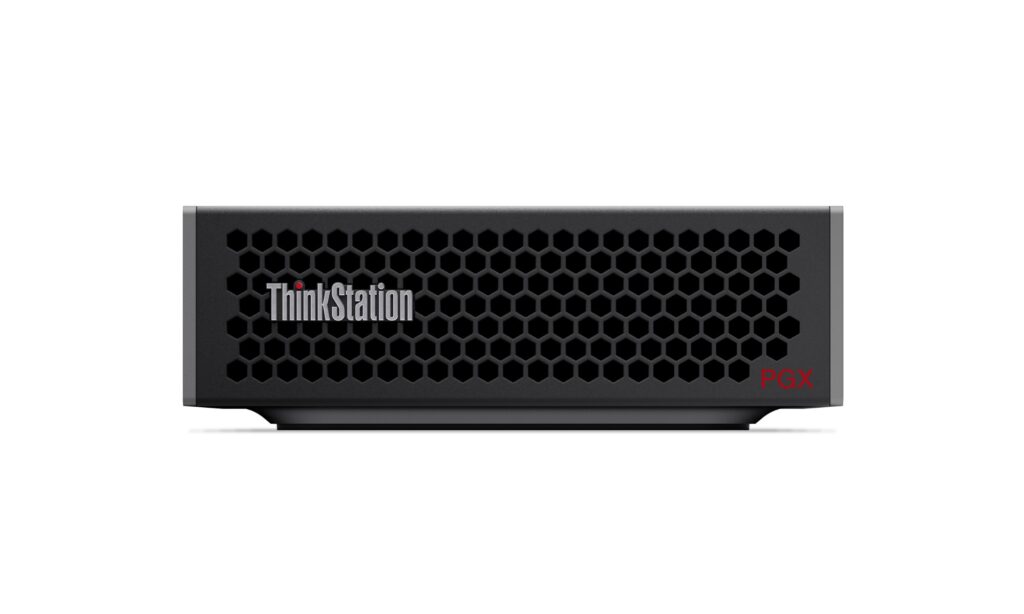
As the demand for AI development continues to grow, professionals are seeking efficient solutions that can handle complex workloads without relying on cloud resources. The Lenovo ThinkStation PGX addresses this need by providing a powerful and compact workstation designed specifically for AI tasks. Its small form factor makes it suitable for office environments while still delivering high performance through its integrated NVIDIA GB10 Grace Blackwell Superchip.
By preloading NVIDIA’s AI software stack, the ThinkStation PGX simplifies the development process, enabling users to prototype and deploy AI models directly from their desk. This streamlined approach reduces the complexities associated with cloud-based solutions, allowing for a more efficient workflow and enhanced productivity.
Pros
- Compact design suitable for desk use
- Preloaded with NVIDIA AI software stack
- Integrated Grace Blackwell Superchip for high performance
- Supports on-device AI development
- Secure sandboxed environment for prototyping
- Energy-efficient system-on-a-chip solution
Cons
- Limited expandability due to small form factor
- Potentially high initial investment
- May require specific technical knowledge for optimal use
- Not ideal for users needing extensive graphical capabilities beyond AI tasks
Who It’s For
This workstation is ideal for AI developers, data scientists, and machine learning engineers who require a powerful yet compact system for local AI model development. It suits professionals who prefer a secure environment for experimentation and those looking to reduce dependency on cloud services.
How We Evaluated
To evaluate the Lenovo ThinkStation PGX, we considered its specifications, performance benchmarks, and ease of use for AI development tasks. We compared it against similar workstations focusing on processing power, memory capacity, and software integration. Performance was measured through common AI development tools such as PyTorch and Jupyter Notebooks, assessing factors like model training speed and overall system responsiveness.
Additionally, we reviewed user feedback and expert opinions to gauge real-world performance and reliability. Key benchmarks included energy efficiency, multitasking capabilities, and the ability to handle large datasets, which are critical for AI applications.
Affiliate Disclosure: This article contains affiliate links. When you purchase through links on our site, we may earn a commission at no additional cost to you. Our editorial team independently selects products based on research and testing. We only recommend products we genuinely believe in.